
Five Major Causes of Family Conflict
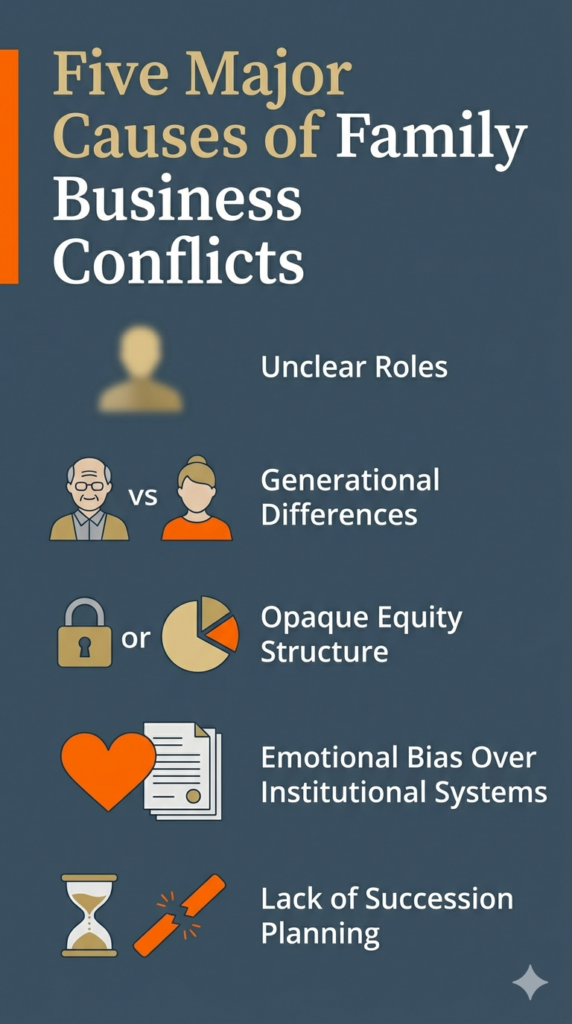
Family enterprises rarely fall apart because of market forces alone. More often, internal tensions—rooted in unclear roles, generational differences, or governance gaps—slowly erode trust and unity. Understanding the common triggers of conflict is the first step toward building a resilient, harmonious family system. Below are five major causes of family conflict, along with practical ways to prevent them.
1. Unclear Roles Among Siblings
When siblings enter the business without clearly defined responsibilities, conflict becomes almost inevitable.
One sibling may handle operations while another contributes minimally yet expects equal rewards.
- Ambiguous authority leads to disagreements over who has the final say.
- Perceived inequality fuels resentment and long‑term tension.
How to prevent it:
Establish formal job descriptions, performance expectations, and reporting structures. A transparent governance system ensures that contribution—not birth order—determines responsibility.
2. Second Generation vs. Third Generation: Clashing Values
Different generations grow up in different eras, shaping distinct worldviews.
The second generation often prioritizes stability and tradition.
- The third generation may push for innovation, digital transformation, or global expansion.
- Without structured dialogue, these differences escalate into strategic conflict.
How to prevent it:
Create platforms such as family councils or structured family meetings where generations can discuss vision, values, and long‑term goals in a respectful, moderated environment.
3. Lack of Transparency in Shareholding
Few issues trigger conflict as quickly as unclear ownership.
If share distribution criteria are not communicated, family members may suspect favoritism.
- Confusion between ownership and management roles leads to power struggles.
- Unclear succession of shares can spark disputes after the founder’s passing.
How to prevent it:
Develop a transparent ownership structure supported by shareholder agreements, trusts, or a family constitution. Clear rules reduce speculation and protect long‑term stability.
4. Emotions Overriding Governance
Family relationships can easily spill into business decisions.
Decisions made based on emotion rather than merit weaken professionalism.
- Conflicts become personal, making resolution difficult.
- “Talking it out” replaces structured processes, leading to inconsistent outcomes.
How to prevent it:
Implement professional governance mechanisms—boards, external advisors, and formal decision‑making processes—to ensure objectivity and fairness.
5. No Succession Plan: A Vacuum That Invites Conflict
When leadership transition is unclear, family members naturally form factions.
- Successors may be unprepared, causing management and employees to lose confidence.
- Sudden leadership changes create instability and internal competition.
How to prevent it:
Develop a long‑term succession plan that includes training, gradual involvement, and clear criteria for leadership readiness.
Conclusion
Family conflict is not inevitable—it is preventable. With transparent governance, structured communication, and early planning, families can transform potential tensions into long‑term unity. A well‑governed family enterprise not only preserves wealth but also strengthens relationships across generations.